

Hair loss is not just a physical change for both men and women; it is a process with deep psychological impacts. Not seeing your formerly thick hair when you look in the mirror can lead to a lack of self-confidence and a feeling of falling behind in social life. Fortunately, the rapidly advancing modern medical technologies of today offer a permanent and incredibly natural solution to this problem. At the very peak of these technologies undoubtedly lies the DHI (Direct Hair Implantation) method.
If you are reading this article, you are likely in the decision-making stage of getting a hair transplant, and one of the biggest questions on your mind is this: What are the DHI hair transplant price ranges, and what determines these costs? When you do a brief search on the web, you may have encountered completely contradictory price tags, confusing campaigns, and suspicious packages offered under the guise of “all-inclusive.”
At DHI Premium, we believe that transparency and trust are paramount in the hair transplant process. In this comprehensive guide, we will leave the market’s information pollution aside and transparently address the real dynamics behind DHI hair transplant prices, the factors affecting these costs, and why you should prioritize quality for the hair you will carry for a lifetime.
What is a DHI Hair Transplant and Why is it in Such High Demand?
Before moving on to pricing details, understanding exactly what the DHI method is and why it has become such a popular choice worldwide is critical to knowing what you are buying with the fee you pay.
In traditional hair transplant methods (like classic FUE), the operation consists of two main stages. First, hair follicles are harvested from the nape area (the donor site). Then, channels are opened in the bald or thinning area using medical blades (slits), and the collected follicles are placed into these channels.
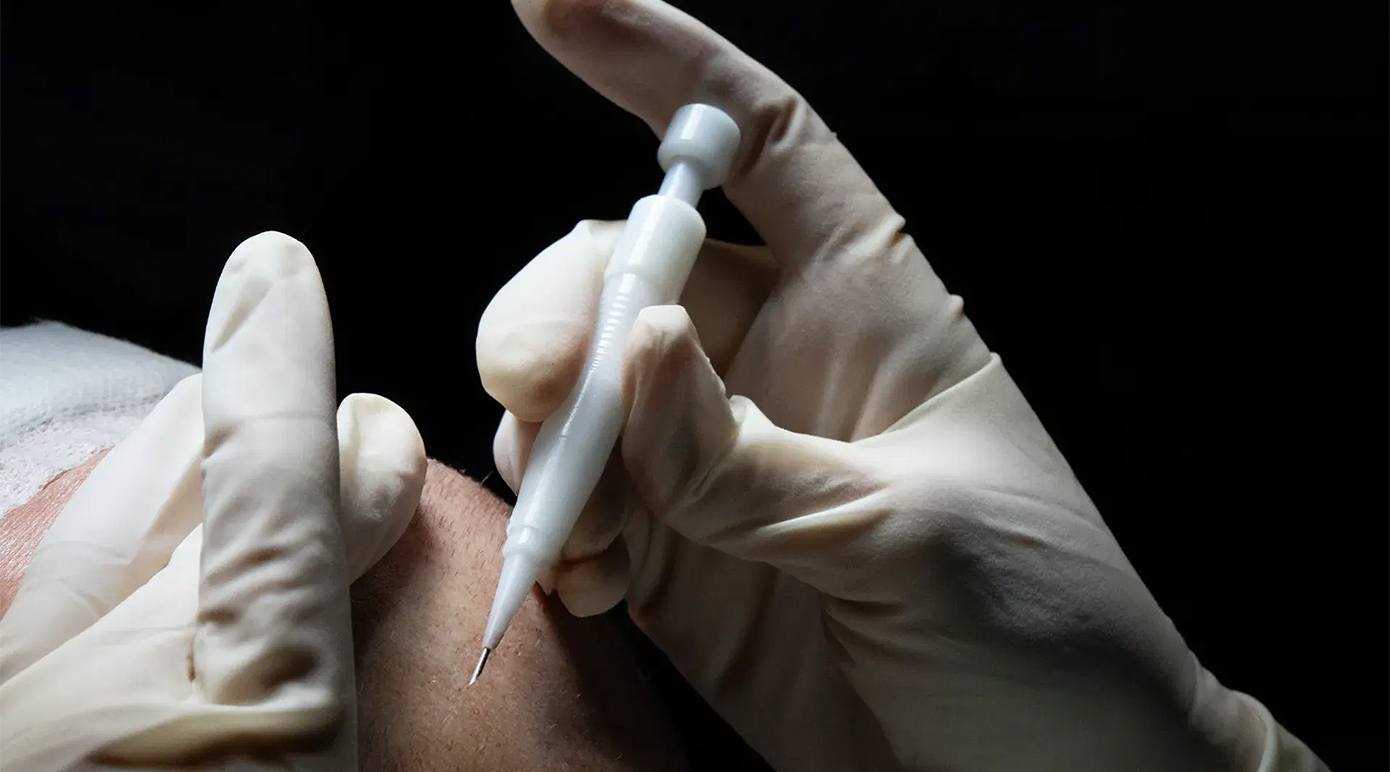
In the DHI method, the “channel opening” process is completely eliminated. This technique utilizes a special medical device called the Choi Implanter Pen, which has a thin, cylindrical, and sharp needle at its tip. The collected hair follicles are placed one by one inside this pen. The specialist physician approaches the scalp at the appropriate angle with the pen and, with a single motion, pierces the skin and leaves the follicle inside simultaneously.
The unique advantages provided by this simultaneous procedure are:
- Maximum Naturalness: The exit angle and direction of the hair follicles can be adjusted with millimeter precision thanks to the Choi pen. This ensures that when your hair grows out, it is absolutely impossible to tell from the outside that a transplant was done.
- Higher Density: Because no pre-made channels are opened, it is possible to implant follicles much more densely between existing hairs without damaging them. It is flawless, especially for individuals who are not completely bald but complain of thinning.
- Unshaven Hair Transplant Opportunity: One of the most beloved features of DHI is that it allows for transplantation (especially in the crown and frontal regions) without the patient having to completely shave their head. This dramatically speeds up the return to social and professional life.
- Rapid Recovery: Since there are no incisions, bleeding, crusting, and tissue trauma are kept to an absolute minimum.
How Are DHI Hair Transplant Prices Determined? (The Behind-the-Scenes Dynamics)
Naturally, the first question many of our patients ask when they contact us is, “How much is the DHI hair transplant price?” However, in the healthcare sector, just like your fingerprint, your hair loss profile is unique to you. Therefore, giving a fixed price without examining the patient is unprofessional and a purely commercial approach.
We can list the main factors that determine DHI hair transplant prices as follows:
- Number of Grafts Needed and the Extent of Hair Loss
A graft is the name given to hair follicle units containing between 1 and 4 strands of hair. The most fundamental factor determining the transplant price is the size of your bald area and the number of grafts that need to be transplanted to cover this area. The operation time, the amount of materials used, and the effort expended are not the same for a patient with mild recession only at the temples versus a patient whose crown area is completely exposed. Your condition is typically analyzed according to the Norwood or Ludwig hair loss scales used in dermatology and aesthetic surgery, and a graft plan (and consequently, a cost) is mapped out accordingly.
- Choi Pen and Medical Material Costs
The most important factor distinguishing the DHI method from classic FUE and pushing its cost slightly higher is the technology used. The needles of Choi Implanter pens are single-use and have different tip diameters depending on each patient’s hair strand thickness (fine, medium, coarse). During a DHI operation, a cycle is established where assistants constantly load follicles into the pens so the physician can work rapidly without pausing. In this operation, 4 to 6 expensive Choi pens are actively used simultaneously. The cost of these high-quality, imported medical tips directly reflects on the total price.
- The Physician’s Expertise and the Size of the Team
A DHI hair transplant is absolutely not a simple procedure that an ordinary technician can perform. Adjusting the needle’s entry angle into the skin (usually 40-45 degrees), its depth, and its harmony with existing hair follicles is like creating a purely medical work of art. The slightest mistake during this process can cause the follicle to die or the hair to grow straight up or backwards. For this reason, DHI must be performed by highly experienced specialist doctors with excellent manual dexterity and an advanced aesthetic vision. Furthermore, DHI operations require a large medical team working in perfect coordination to reduce the time the grafts spend outside the body to zero. A higher number of specialists on the team is also a factor affecting the price.
- Duration of the Operation
While a 4,000-graft transplant takes an average of 5-6 hours in traditional methods, this duration can extend to 8-10 hours, and sometimes spread over two days in the DHI technique, as the follicles must be placed individually with immense precision. As the operational time a clinic dedicates to you increases, labor costs will naturally shift.
- Clinic Equipment and Post-Procedure Support
A hair transplant is not a process that ends on the operating table. In reputable centers like DHI Premium, detailed preoperative blood tests, personalized hairline design, and sterile, fully-equipped operating room conditions are included in the package. Moreover, medical washes, PRP (Platelet Rich Plasma), or mesotherapy applied post-operation to maximize graft retention are also part of the pricing policy.
The Hidden Dangers Posed by Cheap Hair Transplant Centers
While researching on the web, you may have seen centers advertising “shock prices” far below the market average. We must state very clearly: you cannot seek out “cheapness” in healthcare. So, how are these extremely low DHI hair transplant prices possible? Here is the unseen side of the coin:
- Unregulated (Black-Market) Conditions: Procedures performed in converted apartments or offices that do not meet hygiene standards and lack emergency intervention equipment carry severe infection risks.
- Non-Doctor Teams: In low-priced places, the operation is usually performed not by doctors, but by “assembled” teams of daily wage workers with no medical training. A doctor is only shown to you during the initial consultation, but assistants handle the actual procedure.
- Donor Area Massacre (Overharvesting): In inexperienced hands, an excessive and disproportionate number of follicles are extracted from your nape. This is called “overharvesting.” As a result, permanent scars and bald spots that will never heal occur on your nape.
- Pluggy Appearance (Doll’s Hair): As a result of incorrect angle adjustments, an unnatural appearance emerges where hair grows straight up and the directions do not match.
- Revision Costs: Correcting a poorly done hair transplant (revision transplant) is much harder, more arduous, and more expensive than the initial transplant. Sometimes, because the donor area is completely ruined, the possibility of correction may not even exist.
Therefore, when researching DHI hair transplant prices, instead of asking a clinic, “How much of a discount can you give me?” you should ask vital questions like, “Who will personally perform my operation? What technological tools do you use? What is your post-operative follow-up process like?”
Classic FUE or DHI? Which Fits Your Budget?
Many patients find themselves caught between FUE and DHI. Looking at it from a price perspective, the DHI procedure is on average 20% to 40% more expensive compared to the classic FUE method due to the special pens, longer working hours, and extra personnel requirements mentioned above.
However, the issue must be approached not just as “price,” but as “value and benefit.” If your hair loss is not very advanced, if there is thinning only in certain areas, if you do not want to cut your existing hair, and if you have to return to work/social life within a few days, the price difference you pay for the DHI method will absolutely be worth the comfort and natural result you receive. During the preliminary consultation, DHI Premium specialists will examine your hair structure and transparently explain which method you truly need. We will never force a method on you simply because it is more expensive if you do not need it.
Why Does the Whole World Choose Turkey for Hair Transplants?
If you read foreign forums or international blogs, you can see that DHI hair transplant prices in Europe or America range between $8,000 and $15,000. Turkey, thanks to both its geographical location and exchange rate advantage, is the capital of global medical tourism.
But what truly makes Turkey number one isn’t just that it is “affordable.” Turkish physicians and hair transplant specialists, who have handled tens of thousands of cases over the years, have achieved a manual dexterity and experience that virtually no other colleagues around the world can match. As DHI Premium, we are proud to offer the VIP transfers, luxury hotel accommodations, and translator support we provide to our international patients to our domestic patients as well, with accessible pricing policies at the same quality standards.
The DHI Premium Difference: How Does Our Process Work?
From the moment you contact us until the day you look in the mirror and smile at your new hair, we at DHI Premium are by your side.
- Free and Detailed Hair Analysis: During your preliminary examination (which can also be done online via photographs if you wish), your hair thickness, scalp elasticity, and donor area density are measured.
- Realistic Expectations and Design: A frontal hairline is designed to best suit your age, facial features, and expressions, strictly taking the golden ratio into account. We never make unrealistic promises like “You will return to your 18-year-old hair”; we aim for the most aesthetic and natural appearance.
- Painless Local Anesthesia: For our patients with needle phobia, we minimize the sensation of pain with needle-free anesthesia devices (pressurized systems).
- Meticulous Extraction and Implantation: Grafts are extracted using micromotors without being damaged, and rapidly transplanted to their new locations using Choi pens without waiting in cold solutions for long periods.
- Lifetime Support: Your first wash after the procedure is done in our clinic. Your personalized care kit and medications are provided. Your progress is continuously monitored by our consultants in the 1st, 3rd, 6th, and 12th months.
